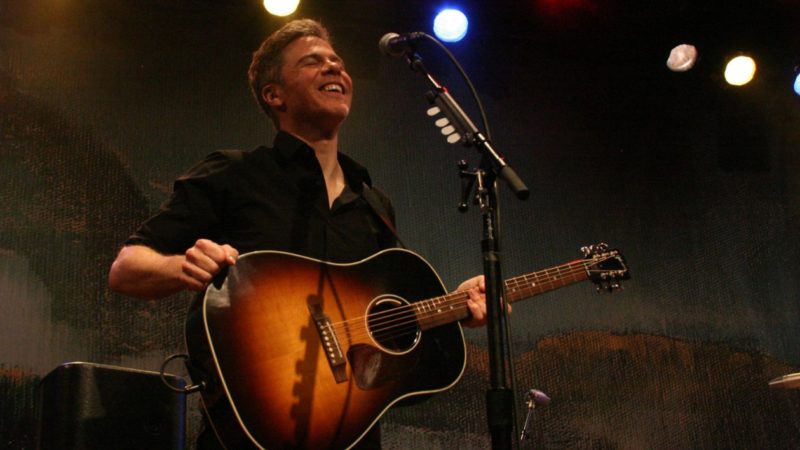
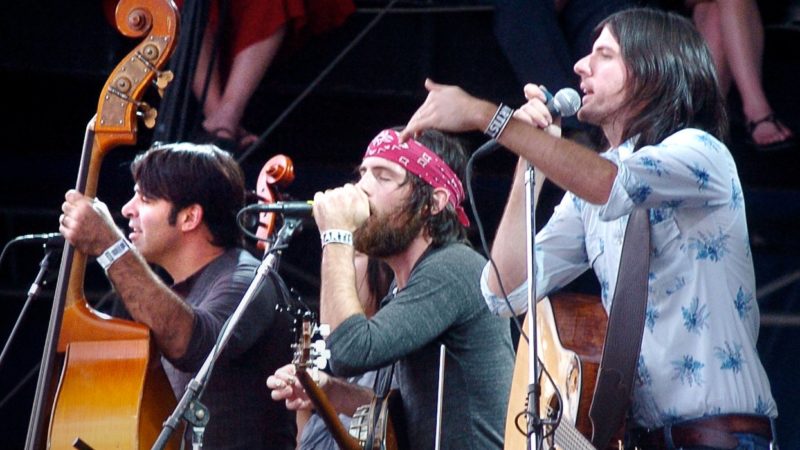
What sustains a band for more than three decades? Not a hit radio band, but a roll-up-your-sleeves/drive to the next gig overnight/carry your own gear up the steps and night after night make people happy kind of band. One that makes them dance; sends them home to come back again—and again. What makes that kind band stay together through relatively few personnel changes? Answer: A good idea; a universal yet somehow unique, good idea.
The Nighthawks sought not so much to reinvent rock and roll, but simply to have it reinvent itself by taking the original ingredients and following—if somewhat loosely—the original recipe. And like good cooks, the individual personalities involved ultimately affected the outcome.
The band was over 10 years old and had baffled the mainstream industry before the term “roots rock” was coined to explain the likes of West Coasters like Los Lobos and The Blasters. By then, the affiliation with many of the living blues greats seemed to brand The Nighthawks a “blues band” despite the fact that they played with Carl Perkins as well as Muddy Waters.
The Nighthawks had its genesis when lead singer-harmonica player extraordinaire Mark Wenner returned to his native Washington, D.C. after six years in New York City, lured back by the success of his friend Bobby Radcliff’s local acclaim with a blues band. Mark joined forces with a then very young Jimmy Thackery and formed The Nighthawks in 1972. They spent a couple of years building The Nighthawks’ reputation with a revolving cast of characters until, in 1974, they decided to get the best rhythm section the area had to offer: Jan Zukowski on bass and Pete Ragusa on drums.
The Nighthawks set off on a musical mystery tour that took them to 49 states and a dozen countries. They played with nearly all the living blues legends as well as a new generation of bands, sometimes called “the Blue Wave”, and released several important albums including the best-selling Jacks and Kingswith Pinetop Perkins, Luther “Guitar Junior” Johnson, Calvin Jones and Bob Margolin. (Servern Records 2017)
Could not resist the throwback video..enjoy

You Might also like
-
Lyle Lovett
Lyle Lovett
Lyle Pearce Lovett is an American singer, songwriter, actor and record producer. Active since 1980, he has recorded 13 albums and released 25 singles to date, including his highest entry, the number 10 chart hit on the U.S. Billboard Hot Country Songs chart, “Cowboy Man”. Wikipedia
Post Views: 4,058 -
Eilen Jewell
From: Bernard Zuel – Music Journalist
FULL DISCLOSURE: WHY THE RULES HAVE CHANGED FOR EILEN JEWELL
MAYBE IT’S THE MIDWEST UPBRINGING of politeness and reserve that lay behind it. Maybe it’s the natural defence of someone who already was out and exposed as an artist in a corner of Americana that values the personal as much as the historical. Whatever it might be with Eilen Jewell, in about 13 years of interviewing her, she has always shown herself adept at talking about her songs and her life in a way that deflected personal revelations.
It’s not that she didn’t answer questions, but those answers made the generalities of her characters the focal point and gave just enough to let us see how she’d build relationships to them but not be defined by them. It was politely done of course, and was not without things to chew on given a sharp intelligence and an eye on American culture whether it was her love of Loretta Lyn and Howlin’ Wolf, the pay gap between the sexes, or political resistance as something of a progressive island in a state that’s anything but.
Well, things have changed with the coming record, Get Behind The Wheel. Not only has Jewell written an album that came out of the Covid-era breakup of her marriage to long-time drummer, co-manager, and co-parent, Jason Beek, and some deaths in her wider family, but she has been talking openly, frankly, about her circumstances.
It’s hard to imagine that was a comfortable transition, not least because growing up in Idaho you kept your business to yourself, but you have to wonder if it has been dragged out of her, or did she feel it was inevitable and stopped fighting.
“It is really new for me to talk about anything having to do with my personal life,” the Boise-based Jewell says. “But this time around it seemed like it would be wrong to not discuss it because this album is so, so directly influenced by everything that I’ve gone through in the past couple of years. I just feel like I would be lying if I said ‘oh, I don’t know, it’s just about people and things’ [she laughs].
“Also the pandemic taught me that that there’s something really important about sharing parts of ourselves. That’s what sharing my music is [and] I guess it dawned on me this actually could be a good thing for me, it could open me up to my fans and there’s a chance there could be some cathartic sharing on both sides.”
There probably won’t be any problems getting her fans to share their thoughts next month when she will spend several weeks in Australia (heaven knows we’re not a quiet bunch), but when you put these things out like Jewell is now doing, not only are you exposing yourself but you are setting the agenda for how things are interpreted. And this is before even considering that Beek is still playing in her band and will be on the tour.
How people interpret your songs and your album, and inevitably yourself, will be shaped by these revelations and explanations. Is that a good thing? Was it even planned?
“The label was saying you’ve got to figure out how to talk about this new album, so I was like, yeah, shoot, I’ve gotta decide how much do I want to disclose? How much do I want to set the stage for these songs?,” she says. “Because, yeah, in the past I’ve not done that and thought that the songs should stand on their own and people can interpret them how they want. People are still free to interpret them however, obviously, but this album really did occur at a particular point in time for me. It was a disaster of a moment in my life this album was born out of, beyond anything else I’ve ever experienced, and I felt this album deserved an exception to my normal rule.” It was time? At 43, maybe it’s as simple as that.
“I guess I do want to talk about this stuff, this stuff being the pandemic, the divorce that came out of that, or coincided with it, and then family losses, people near and dear to me – not even Covid-related, but just one after another,” Jewell says. “For the first time in my life it feels cathartic to talk about what was going on behind the scenes. I don’t think it’s necessary information to appreciate the album, but there’s a few Neil Young albums where I gleaned he was going through a particular thing in his life and then read later that in fact, yes that’s happening, and something about that makes me appreciate the album just a little bit more. I have a sense of who he is more.”
From a long low base of knowledge about the album so far – it’s not yet available to media, let alone the public, though we will hear some songs from it at her March shows – a title like Get Behind The Wheel suggests maybe taking control of her life, or at least setting the direction. How did she handle this resetting and reclaiming of control?
“It’s really been a mixed bag,” she confesses. “I think when I wrote that song – the song that contains that phrase ‘get behind the wheel’ is called Alive – I felt so inspired to take control and have agency, it was all very new. I was like, well, so much is crashing down around me but this is an opportunity to just up inside my life in a really authentic way. And that’s still present, but I’m also realising that it’s much harder than it sounds, and sometimes [she laughs ruefully] it’s awful.” No one would blame her for looking away.
“There’s part of me that would just love to drift around and say ‘I don’t know, someone else take the wheel: I’m getting tired already’,” says Jewell. “But I was guilty of some of that for many years, going with the flow with my career, and my personal life too … being cooperative, and they really comes at a cost eventually. You can’t keep whittling your life away like that. Eventually you realise that your heart is not fully in it, and there’s always a reckoning with that.” When she looks at who she was, even three years ago, and who she is now, how does she judge that person?
“I … think … that … person … was … somewhat,” she says slowly, before a long pause. “Somewhat overeager to find distractions. The old me really didn’t want to look at life just as it is. The old me was always kind of looking into the future, thinking about how things will be better or should be better, or the past. The here and now was something that I tended to avoid. “But all we really have is the here and now. The past is gone and the future is a fantasy.”
Post Views: 2,238 -
Dion
Dion (Dimucci)
“Dion, like a circling star that never fades, generates the energy and fire we need to pull ourselves up and start again.” (Pete Townsend)
Dion may be a household name and Hall of Famer but has earned a post here as he remains relevant at 82.
Currently charting with a new record, Stomping Ground, featuring collaboration with over a dozen major artists.

Read and remember:
Dion DiMucci had a career unlike any other in 20th century popular music, one that took him from harmonizing doo wop on the streets of the Bronx to baring his soul on a series of singer/songwriter albums in the ’70s, spending his later years bringing his blues into the 21st century. First famous for the hits he had as a teen with the Belmonts, “The Wanderer” and “Ruby Baby” were covers that established Dion as a solo star in the late ’50s, while “Runaround Sue” and “Lovers Who Wander,” which he co-wrote, revealed a songwriting talent that would flourish over the years. DiMucci kept recording after the British Invasion changed the rock & roll landscape of the ’60s, but he didn’t have another big hit until the bittersweet “Abraham, Martin and John” in 1968, a single that introduced a period as an idiosyncratic singer/songwriter, an era encapsulated on the 1975 cult classic Born to Be with You. Dion spent some time singing Christian music and oldies before returning to fresh material with 1989’s Dave Edmunds-produced Yo Frankie. From that point forward, DiMucci split the difference between R&B throwbacks and new tunes, eventually settling into a blues groove, beginning with 2006’s Bronx in Blue and stretching into 2021’s Stomping Ground.
When Dion began recording in the late ’50s, it was as the lead singer of a group of friends who sang on Bronx street corners. Billing themselves Dion & the Belmonts (Dion had released a previous single with the Timberlanes), their first few records were prime Italian-American doo wop; “I Wonder Why” was their biggest hit in this style. Dion‘s biggest single with the Belmonts was “A Teenager in Love,” which pointed the way for the slightly self-pitying, pained odes to adolescence and early adulthood that would characterize much of his solo work.

Dion went solo in 1960 (the Belmonts did some more doo wop recordings on their own), moving from doo wop to more R&B/pop-oriented tunes with great success. He handled himself with a suave, cocky ease on hits like “The Wanderer,” “Runaround Sue,” “Lovers Who Wander,” “Ruby Baby,” and “Donna the Prima Donna,” which cast him as either the jilted, misunderstood youngster or the macho lover, capable of handling anything that came his way (especially on “The Wanderer”).
In 1963, Dion moved from Laurie to the larger Columbia label, an association that started promisingly with a couple of big hits right off the bat, “Ruby Baby” and “Donna the Prima Donna.” By the mid-’60s, his heroin habit (which he’d developed as a teenager) was getting the best of him, and he did little recording and performing for about five years. When he did make it into the studio, he was moving in some surprisingly bluesy directions; although much of it was overlooked or unissued at the time, it can be heard on the Bronx Blues reissue CD.
In 1968, he kicked heroin and re-emerged as a gentle folk-rocker with a number four hit single, “Abraham, Martin and John.” Dion would focus upon mature, contemporary material on his late-’60s and early-’70s albums, which were released to positive critical feedback, if only moderate sales. The folk phase didn’t last long; in 1972 he reunited with the Belmonts and in the mid-’70s cut a disappointing record with Phil Spector as producer. He recorded and performed fairly often in the years that followed (sometimes singing Christian music), to indifferent commercial results. But his critical rep has risen steadily since the early ’60s, with many noted contemporary musicians showering him with praise and citing his influence, such as Dave Edmunds (who produced one of his periodic comeback albums) and Lou Reed (who guested on that record). Dion continued to be active as the 21st century opened, releasing Déjà Nu in 2000, Under the Influence in 2005, and Bronx in Blue in 2006. His first major-label album since 1989’s Yo Frankie, Son of Skip James was released by Verve in 2007, while 2008’s Heroes: Giants of Early Guitar Rock saw him tackling 15 songs from the classic rock & roll era. Influenced by a conversation with rock critic Dave Marsh about his long and still relevant career, and a dare from his wife Susan to prove it, Dion cut Tank Full of Blues, producing and playing the guitars himself on the recording and writing or co-writing all but one track on the set. Issued on Blue Horizon, it is the final recording in the trilogy that began with Bronx in Blue.
Dion signed to Instant Records in 2015 and immediately set to recording a new studio album. Entitled New York Is My Home, its first single and title track — a duet with Paul Simon — was pre-released in November digitally and as a striking video. The album was issued in the winter of 2016.
Then the singer/songwriter and Norton Records surprised everyone. In 1965, DiMucci was signed to Columbia, and had cut 15 new songs — all produced by Tom Wilson, who was recording Bob Dylan in the same studios at roughly the same time — for an album that the label, for whatever reason, decided not to release. Dion left the label over the decision. Some tracks were issued on singles, others later on various compilations. But for over 50 years, the tapes sat. That’s where Norton’s Miriam Linna and Billy Miller came in. They received the rights to release the entire record as it was originally intended, completely remastered from the original tapes. Featuring ten originals, one by Mort Shuman (who had co-written “Teenager in Love” with Doc Pomus for Dion & the Belmonts), and three by Dylan (who had been enamored with Dion since the ’50s). Though Miller passed before it was issued, Kickin’ Child: The Lost Columbia Album 1965 was released by the label in May.
In 2020, Dion released Blues with Friends, a collection of original blues songs performed as duets with such superstar pals as Bruce Springsteen, Paul Simon, Van Morrison, and Billy Gibbons. The album was released by KTBA Records (it stands for “Keeping the Blues Alive”), which brought out a similar set in November 2021, Stomping Ground. Another star-sprinkled set of original songs, Stomping Ground featured guest appearances from Rickie Lee Jones, Boz Scaggs, Keb’ Mo’, Mark Knopfler, and many more. In between those two albums, in November 2020, Dion issued a Christmas single, featuring his versions of “Hello Christmas” (featuring Amy Grant) and “You Know It’s Christmas
Artist Biography by Richie Unterberger – via All Music Guide
Post Views: 4,230