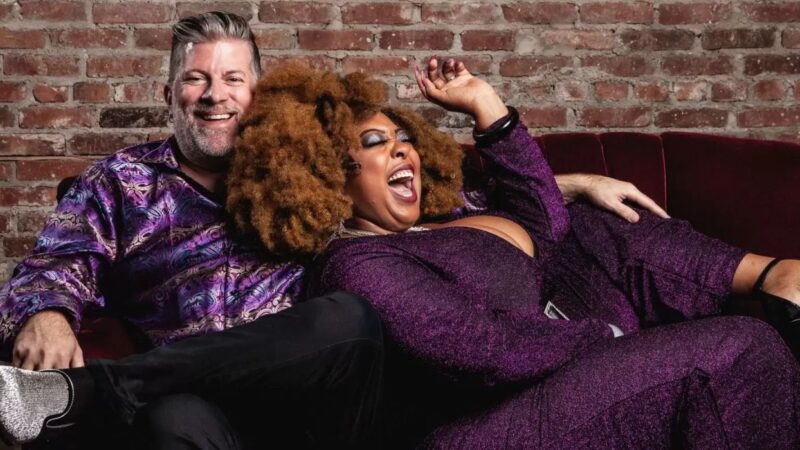
Donna the Buffalo offers everything you want in a roots band — songs that matter, a groove that makes you dance, an audience that spans generations, and a musical voice that evokes a sense of community.
Donna the Buffalo is a cornerstone of the American roots-rock and jam band scene, formed in 1989 in Trumansburg, New York. Led by founding members Tara Nevins and Jeb Puryear, the group is celebrated for a genre-blurring sound that fuses rock, country, zydeco, reggae, and traditional fiddle music. Their name famously originated from a misunderstanding; a friend suggested “Dawn of the Buffalo,” but the band misheard it as “Donna,” and the quirky moniker stuck.

You Might also like
-
Billy Price
Billy Price
Billy Price is a legendary soul-blues vocalist who has spent over five decades as a cornerstone of the Pittsburgh music scene. He first gained national prominence in the mid-1970s as the lead singer for guitar virtuoso Roy Buchanan, appearing on acclaimed albums like That’s What I’m Here For and the high-energy Live Stock. This early exposure established Price as a premier interpreter of “blue-eyed soul,” a reputation he solidified after forming the Keystone Rhythm Band in 1977. Throughout the 1980s, the group became a regional powerhouse, blending gritty urban blues with the smooth, rhythmic phrasing of Southern soul.
In the years following the Keystone Rhythm Band, Price continued to refine his craft with the Billy Price Band. A career pinnacle arrived in 2016 when he won a Blues Music Award for Best Soul Blues Album for This Time for Real, a collaborative project with his long-time idol, Otis Clay. Price has remained remarkably prolific in his later years, releasing celebrated albums such as Reckoning and Dog Eat Dog, both of which earned further award nominations. His 2024 release, Person of Interest, marked a significant creative milestone as his first collection consisting entirely of original material. Beyond his musical life, Price maintained a long-term professional career in corporate communications at Carnegie Mellon University until 2023. Now fully retired from his “day job,” he continues to tour extensively across the United States and Europe, remaining a vital force in the international blues community.
Post Views: 6,299 -
Rodney Crowell
Born in 1950 in Houston, Texas, Rodney Crowell has built a career as one of the most significant figures in the evolution of Americana music. Raised in a musical household where his father led a honky-tonk band, Crowell began playing drums in that group at age 11. His journey took him to Nashville in 1972, where he befriended a circle of legendary songwriters, including Guy Clark and Townes Van Zandt. This early period was formative, as Crowell absorbed the craft of songwriting with a literary and poetic lens that would define his life’s work. His talent was quickly recognized by Emmylou Harris, who recorded his song “Bluebird Wine” and invited him to join her famous Hot Band as a guitarist and harmony singer in 1975.
During the late 1970s and early 1980s, Crowell established himself as a premier songwriter for other artists. His compositions reached the top of the charts via icons like Johnny Cash, Waylon Jennings, and Bob Seger, whose recording of Crowell’s “Shame on the Moon” became a massive pop and country success. Crowell also served as a producer, notably for his then-wife Rosanne Cash, helping to shape the sound of neo-traditionalist country music. However, it was his 1988 solo album, Diamonds & Dirt, that made him a superstar in his own right. The album achieved the unprecedented feat of producing five consecutive #1 country singles, including “After All This Time,” which won him his first Grammy for Best Country Song.
As the 1990s progressed, Crowell consciously moved away from the mainstream country machine to pursue more personal and autobiographical projects. This shift began in earnest with the 2001 release of The Houston Kid, a semi-autobiographical collection that explored his childhood and roots with stark honesty. This record, along with follow-ups like Fate’s Right Hand and The Outsider, is regarded by critics and Crowell himself as some of his most vital work. His literary prowess eventually extended to the page with his acclaimed memoir, Chinaberry Sidewalks, published in 2011.
Crowell’s later career has been marked by high-profile collaborations and continued innovation. He reunited with Emmylou Harris for the 2013 album Old Yellow Moon, which earned another Grammy for Best Americana Album. He has remained remarkably prolific well into his 70s, releasing projects like the Jeff Tweedy-produced The Chicago Sessions (2023) and his 20th studio album, Airline Highway (2025), which features contributions from younger artists like Ashley McBryde and Lukas Nelson. Inducted into the Nashville Songwriters Hall of Fame and recipient of the Americana Music Association’s Lifetime Achievement Award, Crowell is celebrated as a “songwriter’s songwriter” whose influence spans over five decades of American roots music.
Post Views: 262 -
Kathleen Edwards
For decades, Kathleen Edwards has been a cornerstone of North American roots music.
Since making her debut with 2002’s Failer, she’s spent the 21st century occupying the grey area between genres, swirling together her own mix of alt-country, folk, and heartland rock & roll. It’s a sound that has earned its creator more than a half-dozen Juno nominations, as well as Top 40 success on both sides of the Canadian/American border. Now in her third decade as an artist, Kathleen Edwards has done more than carry the torch of songwriting heroes like Tom Petty, Neil Young, and Lucinda Williams — she’s opened the door for others, too, inspiring a new generation of artists who, like her, blur the boundaries between genre and generation.
A native of Ottawa, Ontario, Edwards was still in her early 20s when she released the critically-acclaimed Failer. The album’s warm, woozy sound — crystallized on radio hits like “Six O’Clock News” — quickly turned her into one of the era’s alt-country heroes. From the very start, though, Edwards’ music seemed to exist somewhere out of time, resisting categorization even as Failer received a Juno nomination for “Roots & Traditional Album of the Year.”
“No one knew what to call my type of music back then,” she says of those early years. “The Americana genre didn’t exist yet, so they couldn’t categorize me. I just made the kind of music I wanted to make.”
Edwards continued blazing her own trail with follow-up albums like Back to Me and Asking for Flowers. By the time Voyageur arrived in 2012, Americana very much did exist as a genre, and Edwards found herself riding a newfound commercial peak. The album reached Number 2 on the Canadian Albums Chart and Number 3 on Billboard’s Folk Albums chart. Even so, a busy decade on the road had left her exhausted. After touring in support of Voyageur’s release, Edwards left the music business altogether and moved to suburban Ontario, where she opened a coffee shop called — defiantly — “Quitters.”
“Before I turned 30, I toured the world and put out nearly four records, performed on TV, and had an incredible run,” she says of her first 10 years in the spotlight. “What’s interesting is that I walked away from all of it, too — and when I came back, I felt better than the person who put out Failer.”
By the late 2010s, Edwards felt recharged and revitalized. When a phone call arrived from Maren Morris, who was looking for songwriting partners for a new project, Edwards jumped at the chance to collaborate. The two musicians co-wrote “Good Woman,” which appeared on Morris’ Grammy-nominated album Girl in 2019. Back home in Canada, Edwards continued to write new material, eventually partnering with producer Ian Fitchuk for the album Total Freedom. Released in 2020, the album expanded her sound and her audience, boosted by two hit songs — “Options Open” and “Hard on Everyone” — that both reached the Top 30 on the Triple A chart in America. Total Freedom didn’t just mark her return to the music industry. It was a rebirth, too.
What’s next? New music, of course. She and Grammy-winner Jim Scott co-produced and released an album called Covers, which pays homage to some of her songwriting heroes – Tom Petty, REM, John Prine, Bruce Springsteen, et al. Edwards remains a fan of “ripping guitar riffs and good songs,” and she’s combining both into a follow-up album co-produced by Grammy-winners Jason Isbell and Gena Johnson that will showcase her legacy as well as her evolution.
She maintains a presence on the road, too, playing her own gigs one minute and sharing shows with her heroes — including Willie Nelson, John Fogerty, and Bob Dylan — the next.
“The amount of things I’ve gone through might make someone else quit…but quitting doesn’t quite do it for me,” she says. “I can’t help but want to write great songs, connect with people, and see what’s ahead. I don’t love looking behind, even though it’s one of the ways we can see what we’ve done, so I’m looking forward.” from High Road Touring bio
In keeping with her love of dogs and the great photo used on this post…give a listen to “Who Rescued Who”
2025 – new record out now “Billionaire”
Post Views: 1,538