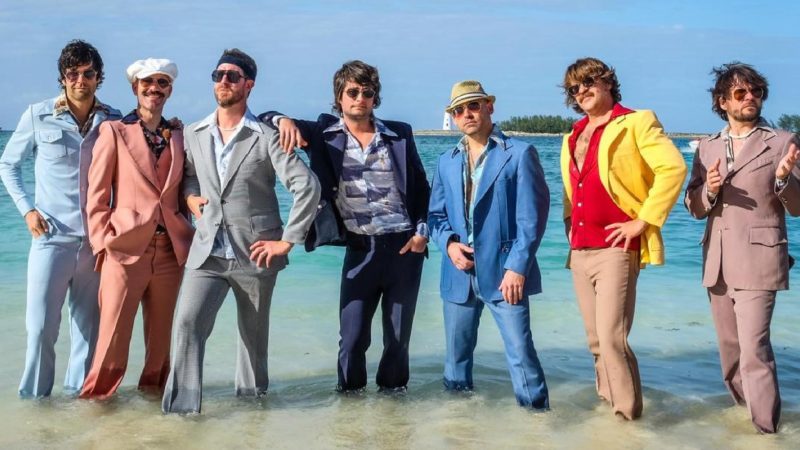
A week of music immersion on board a mid-sized cruise ship.
That is a description of Cayamo, or of other amazing music cruises that cover many genres.
Spending a week with Dawes, Jason Isbell, Kathleen Edwards, Paul Thorn, Rickie Lee Jones, Sierra Hull, Della Mae, and Rodney Crowell featured Roaming the Arts’ favorites. And also allowed us to discover new artists, which is our mission.
Among the artists we came to know, check out these: Watchhouse, Milk Carton Kids, Brandy Clark, Bronwyn Keith-Hynes, Crys Matthews, Judy Blank. Click below for others.
To check out the complete lineup with a link to each artist, click here.
Sixthman‘s tagline, “LIVE LOUD,” speaks to the audience and appears thoroughly appreciated.
Watch this video. It shows off the vibe and the wealth of talent.
You Might also like
-
Jon Cleary
Jon Cleary’s love and affinity for New Orleans music goes back to the rural British village of Cranbrook, Kent, where he was raised in a musical family. Cleary’s maternal grandparents performed in London in the 1940s, under the respective stage names Sweet Dolly Daydream and Frank Neville, The Little Fellow With The Educated Feet – she as a singer, and he as a crooner and tap dancer.
As a teen Cleary grew increasingly interested in funk-infused music and discovered that three such songs that he particularly admired – LaBelle’s “Lady Marmalade,” Robert Palmer’s version of “Sneakin’ Sally Through the Alley,” and Frankie Miller’s rendition of “Brickyard Blues” – were attributed to Allen Toussaint as either the songwriter, the producer, or both. Cleary’s knowledge of Toussaint’s work expanded significantly when his uncle returned home to the U.K., after a two-year sojourn in New Orleans, with a copy of a Toussaint LP and two suitcases full of New Orleans R&B 45s.
In 1981 Cleary flew to New Orleans for an initial pilgrimage and took a cab straight from the airport to the Maple Leaf Bar, a storied venue which then featured such great blues-rooted eclectic pianists as Roosevelt Sykes and James Booker. Cleary first worked at the Maple Leaf as a painter, but soon graduated to playing piano there – even though his first instrument was the guitar, which he still plays and has recently reintroduced into his live performances.
As word of Cleary’s burgeoning talent began to spread around town, he was hired by such New Orleans R&B legends as Snooks Eaglin, Earl “Trick Bag” King, Johnny Adams, and Jessie “Ooh Poo Pah Doo” Hill, while also gaining the respect of the great Crescent City pianists Dr. John and the late Allen Toussaint. Years later, in 2012, Cleary recorded a critically acclaimed album of all-Toussaint songs entitled Occapella.
Today, Cleary’s work pays obvious homage to the classic Crescent City keyboard repertoire created by such icons as Jelly Roll Morton, Fats Domino, Professor Longhair, Art Neville, Dr. John, and James Booker – while also using it as a launching pad for a style that incorporates such other diverse influences as ’70s soul and R&B, gospel music, funk, Afro-Caribbean and Afro-Cuban rhythms, and much more.Deciding to stay in New Orleans, Cleary recorded his first album of nine, to date, in 1989. His ever-elevating profile led to global touring work in the bands of Taj Mahal, John Scofield, Dr. John, and Bonnie Raitt. Cleary has led his own group, the Absolute Monster Gentlemen, for over two decades now, but he still collaborates frequently with these old friends. At the 2018 New Orleans Jazz & Heritage Festival, for instance, Cleary performed alongside Raitt in a heartfelt tribute to Fats Domino.
Post Views: 4,889 -
Neal Francis
Neal Francis
Liberated from a self-destructive past and born anew in sobriety, Francis has captured an inspired collection of songs steeped in New Orleans rhythms, Chicago blues, and early 70s rock n’ roll. His music evokes a bygone era of R&B’s heyday while simultaneously forging a new path on the musical landscape. Colemine Records“The reincarnation of Allen Toussaint.” Craig Charles, BBC Radio 6
“Think New Orleans meets the Midwest with a little bit of California sun shining in the background.” -TwinCitiesMedia.net
“There’s a good chance you’ll have heard of Francis by the time the year is over…classic Funk, Soul and R&B.” Cincinnati CityBeat
“…gleefully mired In 70s style funk.” – NPR
“Soulful style…uplifting vibe…” – Dusty Groove
“Instant Americana-funk classic…R&B, blues and touches of gospel and good old fashioned funk merge into pure beauty and soul here, making the appetite and excitement for whatever Francis does next all the more intense.” – Record Crates United
Post Views: 3,369 -
Peter Wolf
A Cure for Loneliness manifests the same vibrant passion for music that’s motivated Peter Wolf for most of his life. Growing up in an artistic, politically engaged family in the Bronx, he became an early rock ‘n’ roll convert after attending an Alan Freed rock ‘n’ roll revue that included performances by Chuck Berry, Buddy Holly, Jerry Lee Lewis, Little Richard and Frankie Lymon. His thirst for new and old sounds drove him to exploring blues, soul, country, folk and jazz, inspiring weekly visits to Harlem’s Apollo Theatre and leading to acquaintances with many of the music’s surviving originators.
Wolf’s talent as a painter won him a grant to study at the Boston Museum School of Fine Arts. While a student there, he experienced a life-changing epiphany after jumping on stage to sing with a blues band at a loft party. He soon talked himself into membership in that band, The Hallucinations.
“I didn’t join a band to meet girls,” Wolf recalls. “I joined my first band to meet musicians. Painting was a fascination for me, but I was a music fanatic, and sitting in with that band was a born-again type of experience for me. I was transfixed, and myself and some of the guys in the band would check out performances by the musicians we admired so much, like Muddy Waters and John Lee Hooker and John Coltrane and Bill Monroe and the Stanley Brothers. Those roots stayed with me.”
Wolf’s natural loquaciousness won him a job as an all-night DJ on the fledgling FM rock station WBCN. Adopting the persona of “the Woofa Goofa,” he spun raw rock ‘n’ roll and rhythm ‘n’ blues, channeling the spirit of the flashy, fast-talking DJs he’d grown up listening to.
Wolf’s encyclopedic musical knowledge came in handy when he and some like-minded Boston players formed the J. Geils Band, much of whose early repertoire was drawn from Wolf’s vast record collection. The band soon became a local favorite injecting a much-needed jolt of raw, uninhibited rock ‘n’ roll into the ’70s scene and was soon signed by Jerry Wexler for Atlantic Records. Between 1970 and 1983, the J. Geils Band released 13 influential albums, topped the pop single charts with 1981’s “Freeze Frame,” “Love Stinks,” “Centerfold,” and earned a reputation as one of rock’s most exciting live acts, thanks in large part to Wolf’s flamboyant, hyperactive stage presence.
After going solo with 1984’s Lights Out, Wolf continued to stake out new musical territory with the subsequent releases Lights Out, Come As You Are, Up to No Good, Long Line, Fool’s Parade, Sleepless and Midnight Souvenirs, and A Cure For Loneliness. His solo work has seen him collaborate with the likes of Aretha Franklin, Merle Haggard, John Lee Hooker, Mick Jagger, Keith Richards, Little Milton, Wilson Pickett, Shelby Lynne and Neko Case. Wolf temporarily reunited with his J. Geils Band cohorts for live shows on several occasions between 1999 and 2015, but his solo career has remained his creative focus, as A Cure for Loneliness makes clear.
Post Views: 6,102